


 by Tom Gurney
Tom Gurney BSc (Hons) is an art history expert with over 20 years experience
Published on June 19, 2020 / Updated on July 5, 2026
Email: tomgurney1@gmail.com / Phone: +44 7429 011000
Introduction
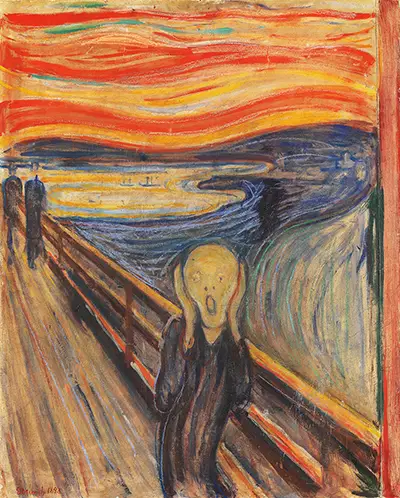
Sick Mood at Sunset: Despair is best understood as part of the red-sky route that leads toward The Scream. The title overlaps with Despair, and that overlap is not an accident to hide. Munch repeated motifs, revised titles and returned to the same emotional landscape in different forms. [2] [4]
The important point is not whether this page names a completely separate subject from Despair. It is that Sick Mood at Sunset helps readers understand the sequence: a road or bridge, a fjord landscape, a red sky, background figures and a foreground person overwhelmed by the scene. From that structure Munch would build The Scream and later Anxiety. [1]
At a Glance
- Artist: Edvard Munch
- Title route: Sick Mood at Sunset: Despair
- Date context: 1892 red-sky precursor route
- Related title: Despair / Sick Mood at Sunset
- Cluster role: Supporting page for The Scream, Despair and Anxiety
Why This Page Matters
This page matters because it explains the naming and motif overlap that can otherwise confuse readers. The flagship Despair page focuses on the Thiel Gallery painting, which the gallery records as Despair with the alternative title Sick Mood at Sunset. This page acts as a companion route, helping readers move from the earlier mood picture toward The Scream and Anxiety. [2]
It also helps correct a common simplification. The Scream did not appear from nowhere. It grew from repeated experiments with a red sky, road, fjord, background figures and a person whose inner state seems to pass into the landscape itself. [1] [5]
Museum Perspective
The Thiel Gallery's object record for Despair is central. It identifies the painting as oil on canvas, dated 1892, and records Sick Mood at Sunset as an alternative title. Its description points to the well-dressed man in the foreground, the sombre mountainous landscape, the red sky and the bridge railing later familiar from The Scream. [2]
The National Museum's text for The Scream gives the clearest developmental statement. It says The Scream is a further development from Sick Mood at Sunset. Despair, with similar colours, format, landscape and background figures. The radical change is the foreground figure. [1]
Looking Carefully
The red sky is the first feature most viewers notice. It should not be treated simply as a background sunset. In Munch's anxiety route, sky, road, fjord and figure work together. The landscape behaves like an emotional field. [6]
The second feature is the foreground person. In Despair and the Sick Mood route, the figure remains more recognisably social than the figure in The Scream. He is a person in a place, not yet the frontal, mask-like sign that later becomes world-famous. [1] [5]
The background figures matter too. They create distance between ordinary movement and the foreground figure's inner state. Other people can continue down the road while the main figure is stopped or overwhelmed. [1]
From Despair to The Scream
The sequence from Sick Mood at Sunset and Despair to The Scream is one of the most useful ways to understand Munch's method. He did not simply illustrate a feeling once. He tested it through repeated images until the figure, landscape and colour became more compressed and more direct. [4] [5]
In Despair, the man is still recognisable. In The Scream, the figure turns outward and becomes harder to classify: person, sign, skull, mask and sound all at once. The background remains related, but the human form has changed. [1]
That change is why Sick Mood at Sunset should not be dismissed as a lesser work. It shows the road before the icon. It lets the viewer see how Munch discovered one of modern art's most powerful images by revising a motif rather than inventing it in a single leap. [5]
Despair, Anxiety and the Red-Sky Route
Anxiety extends the route again. Instead of one figure absorbing the pressure of the red sky, Anxiety gives us a crowd. The emotional state becomes collective. The road and landscape remain important, but the human unit changes. [6]
This makes the red-sky route one of the strongest internal clusters in Munch's work. Sick Mood at Sunset, Despair, The Scream and Anxiety show four related ways of painting modern psychological pressure: mood, bowed figure, frontal icon and crowd. [8]
Comparison Works
- Despair is the essential companion page because it gives the strongest object record and title clarification for the 1892 Thiel Gallery painting. [2]
- The Scream transforms the red-sky setting by changing the foreground figure into a frontal, icon-like body. [1]
- Anxiety extends the motif into a crowd, making modern anxiety collective rather than solitary. [6]
- Melancholy offers another bowed or withdrawn figure in a landscape charged with inner feeling. [4]
- Evening on Karl Johan Street adds the urban crowd route that later helps make Anxiety so unsettling. [6]
Things You Might Miss
- The title overlap is part of the history, not an error to smooth away. [2]
- The background figures help show the difference between ordinary movement and emotional arrest. [1]
- The red sky belongs to a sequence of works, not just to The Scream. [5]
- The foreground figure is still recognisably human before The Scream transforms him. [1]
- The page should be read beside Despair, not instead of it. [8]
Interpretation
The best interpretation of Sick Mood at Sunset: Despair is developmental. It shows Munch working out how a modern emotional state could be painted through colour, setting and bodily position. The red sky is important, but so are the road, railing, fjord, background figures and changing foreground body. [5]
That developmental reading is stronger than treating the work as a simple autobiographical anecdote. Munch's writings about the red sky matter, but the painting is not just a diary entry made visible. It is a constructed image in which the world and the feeling begin to fuse. [7]
Timeline
- 1863: Edvard Munch is born. [3]
- 1892: The Sick Mood at Sunset / Despair route develops in the red-sky fjord setting. [2]
- 1893: The Scream transforms the related landscape and background figures through a radically changed foreground figure. [1]
- 1894: Anxiety extends the route into a crowd image. [4]
- 1944: Munch dies after a career of more than sixty years. [3]
FAQs
The titles overlap. The Thiel Gallery records the 1892 painting Despair with Sick Mood at Sunset as an alternative title. This page treats Sick Mood at Sunset: Despair as a supporting title-route page rather than a duplicate flagship. [2]
The National Museum describes The Scream as developing from Sick Mood at Sunset. Despair, with similar colour, format, landscape and background figures but a radically changed foreground figure. [1]
The red sky is part of a repeated anxiety landscape in Munch's work. It is not just scenery; it helps turn the outside world into emotional pressure. [5]
Read Despair for the flagship version, The Scream for the transformed icon, and Anxiety for the collective crowd version of the same emotional route. [8]
References
- National Museum of Norway, The Scream object/catalogue text, accessed 5 July 2026.
- Thiel Gallery, Despair object record, accessed 5 July 2026.
- MUNCH, "Edvard Munch (1863-1944)," official artist page, accessed 5 July 2026.
- Gerd Woll, Edvard Munch: Complete Paintings, London: Thames & Hudson, 2009.
- Reinhold Heller, Edvard Munch: The Scream, London: Allen Lane, 1973.
- Patricia G. Berman, ed., Edvard Munch: The Modern Life of the Soul, Museum of Modern Art, 2006.
- eMunch, Edvard Munch's Writings: The English Edition, accessed 5 July 2026.
- TheHistoryOfArt.org, Edvard Munch sitemap and local internal-link validation, checked 5 July 2026.